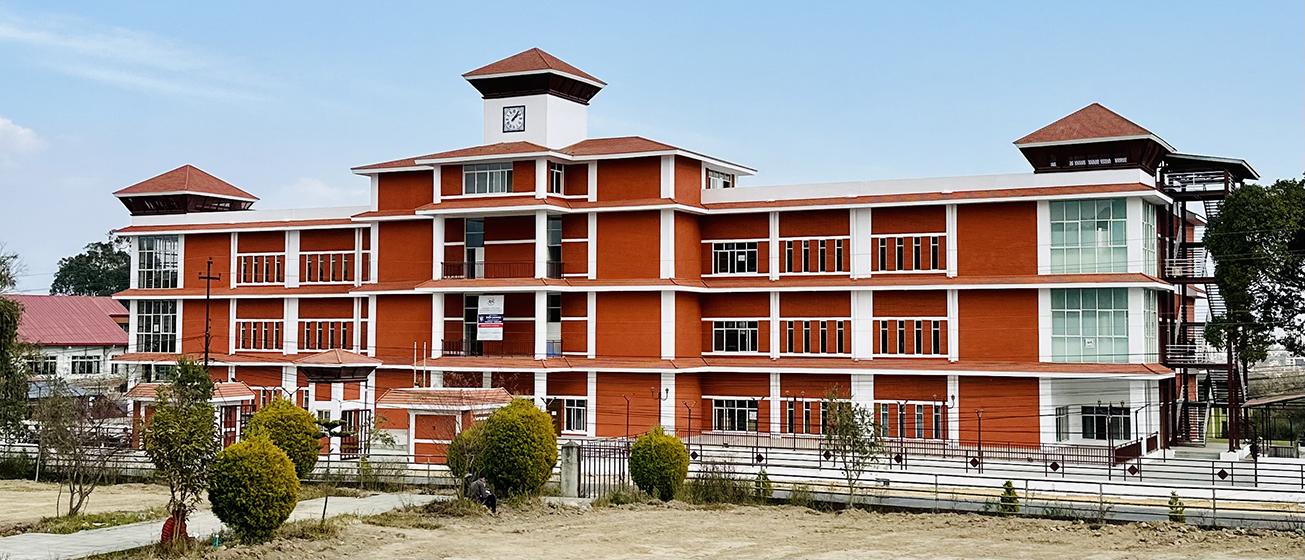
Welcome to TUCL Repository
- Access to a vast collection of academic theses and dissertations
- Wide range of scholarly journals and articles
- Search and browse functionalities for easy discovery of resources
- Accessibility to digital resources anytime, anywhere
- Facilitates research and learning endeavors of TUCL community
- Promoting open access to knowledge and research findings
- User-friendly interface, ensuring ease of navigation and accessibility for users of all levels of expertise
- unique persistent identifier (such as DOI or Handle) to facilitate citation, tracking, and long-term preservation, ensuring the integrity and longevity of scholarly contributions
Communities in DSpace
Select a community to browse its collections.
Recent Submissions
Humans and Non-Huimans relation in Atwood's MaddAddam Trilogy
(2024) Subedi, Bhim Prasad; Bal Bahadur Thapa
This study explores relations between humans and non-humansin Atwood’s MaddAddam Trilogy, comprisingof Oryx and Crake, The Year of the Flood,andMaddAddam. Although the study primarily focuses on MaddAddam, it bringsadequate references of humans and non-humans from Oryx and Crakeand The Year of the Flood. According to this research, MaddaddamTrilogycritiques the symbiotic andindispensable relation of non-human life by depicting a world, where humans use biotechnology to soar in the changed world and have relation with non-humans. Atwood ruptures the dichotomy between human and non-human, showing the coherent relation, species extinction, and ecological degradation and so on are amplified throughhuman practices. She calls for harmony, embodiment of the deep ecologies and adherence to simplicity, sustainability and respect for all life.Despite genetic transformations instigated by humans, the non-human entities exhibit notable resilience and adaptability, with some even developing their own culture and spirituality. Through the trilogy, Atwood emphasizesa need for anethical and respectful relationship between humansand non-humans, and thereby presentsa model of harmonious and more ethical and sustainable co-existence. In order to examine such relationship between humans and non-human entities, this study draws upon theoreticalinsights developed byRosi Braidotti, Cary Wolfe and Jeremy Bentham.
Key words: deep ecology,symbiotic relation,genetic engineering, environmental collapse, harmony
Adoptive feature of Bottom- Dwelling Fishes in the Tinav River
(2024) Kafle, Sima; Santoshi Shrestha
The present study deals with the adaptive features of bottom-dwelling fishes Genus Garra
of Tinau River using cast net and local fishing implement hammering. A total of 201
individuals of two species Garra annandalei (n=83) and Garra gotyla (n= 113) during
September / October, 2023.The study focused on abundance, morphometric analysis,
length-weight relationship, conditional factors, relationship of physicochemical
parameters with fish and comparison collected sample with Central Department of
Zoology, Tribhuvan, University (CDZ TU) museum deposited samples of Garra.. Garra
annandalei has a length-weight relationship with b value 0.21, whereas Garra gotyla has
b value: 0.38. The b value was fewer than 3, indicating that the species display negative
allometric growth. The conditional factor was k = 0.50 for Garra annandalei and k = 0.60
for Garra gotyla, indicating that the species is in good condition. The most of the
physicochemical characteristics were measured within acceptable ranges and relationship
between fish abundance and physicochemical parameters also within good for fish’s
survival. The paired sample t test revealed that there is significant different between
means of two samples also x-ray examined difference between older and newly collected
sample.
Projection of old age in selected Contemporary Nepali Short Stories
(2024) Pandit, Pratibha; Komal Phuyal
This research explores the projection of old age in eleven contemporary Nepali short stories. The research studies the elderly characters in the selected stories from the three anthologies: Durga Karki's Kumari Prasna Haru (2020), Nayan Raj Panday's Jiyara (2020) and Ramlal Joshi's Ba Ama (2022). The study critically evaluates how these authors depict the socio-culturally constructed status of old age, often neglecting the elderly people's needs for agency, identity, and intrinsic value. Using the sociocultural lens of aging literature, Margaret Morganroth Guellette's concept that sociocultural perceptions guide progressive or declining narratives of old age is central to this study. The analysis shows that the elderly characters are presented with stereotypical aging that features degeneration and loss. So, aging characters in the stories are economically and physically weak, socially fragile, and politically marginalized. The study reveals the intergenerational gap, with younger characters undermining the lives of elderly people. This study, thus, unfolds the bitter portrayal of old age, which is seen only through the lens of the decline discourses in the selected short stories. Studying aging through sociocultural dimensions that predominantly highlight negative perceptions overlooks the agency and diverse experiences of elderly people. By focusing on these stereotypes, the dissertation seeks to foreground the voices of elderly people, contributing to academic discourse and debates. This research expects to provide a deeper understanding of aging that accepts their contributions and individual agency within the broader societal settings.
Keywords: Aging literature, old age, intergenerational gap, decline narratives.
